
01 · New York City · 1963–1965
Civil Rights Figuration & Abstract Witness
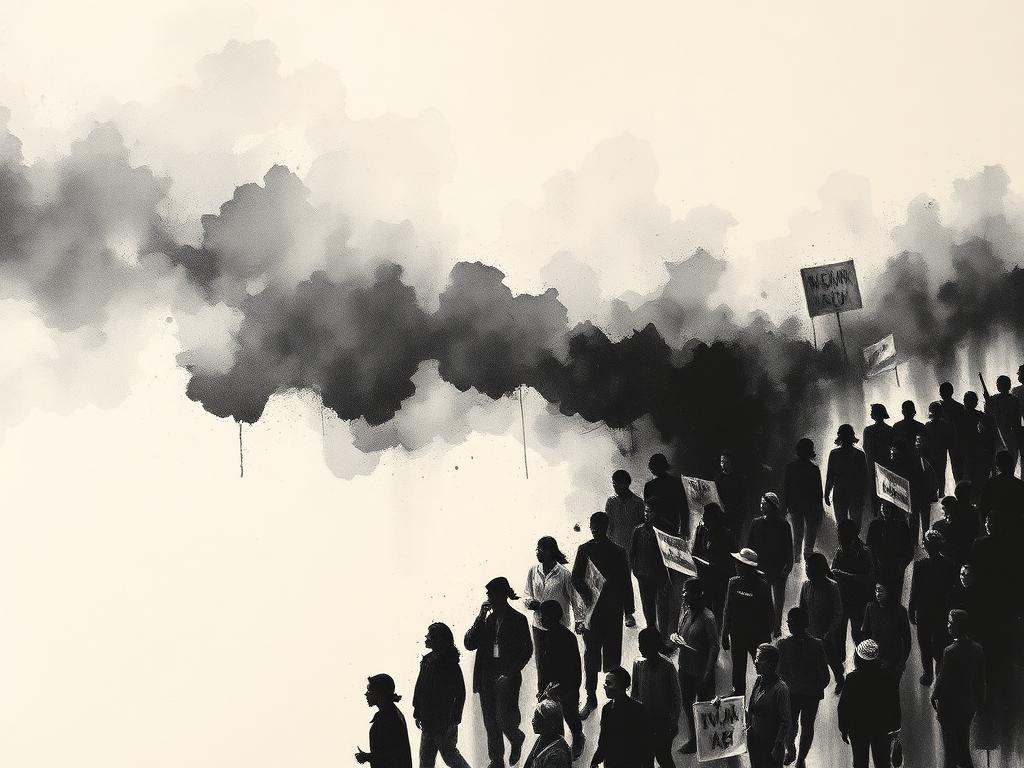
The Spiral collective formed in Romare Bearden's studio in July 1963, when a group of Black artists began meeting weekly to debate what it meant to make art in the middle of the civil rights movement. They didn't share one style — some worked abstractly, some figuratively — but they shared the question of what an artist owed the struggle happening outside the studio door. Their only group show, in 1965, was rendered entirely in black and white: a deliberate constraint that tied their many visual languages together.
Norman Lewis
1909–1979
Lewis was the only Black painter among the first generation of Abstract Expressionists, though the era's museums and critics rarely credited him for it. He built paintings from small calligraphic marks — brushstrokes that read almost like handwriting or musical notation — and let recognizable shapes surface only on a second look: a procession of hooded figures, a crowd under streetlights, a march seen from above. He believed abstraction could carry political weight without turning into illustration.
Look for
- rhythmic calligraphic mark-making
- forms that resolve on a second look
- near-monochrome restraint
- composition paced like jazz improvisation
- crowds implied, not drawn
You've walked the cycle for 01.
Now take that language into the lab: pick your layers, roll the dials, and pull prompts in this style — always carrying Diaspora imagery.